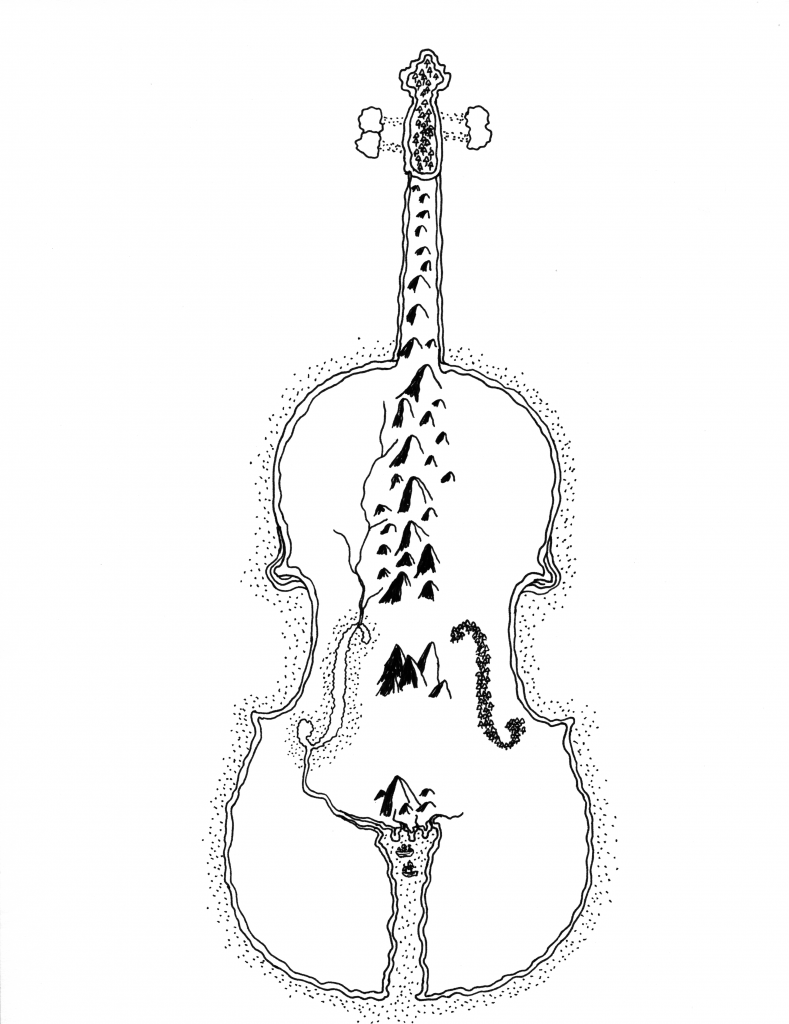
< CLICK the image to explore CELLO MAP!

About
How to?
The Cello Map team

DOWNLOAD NOW!

The Cello Map philosophy

Cello Map is a practical resource for those who are interested in performing and writing contemporary music for cello.

It is a map because it is a physical plan for exploring the instrument, and because the aim is to map ‘actions that a cellist can make’ onto ‘sounds that a cello can produce’. In other words, I have tried to reduce the cello and cellist to scales of actions and sounds, and show how cellists can influence sound (loudness, overtone content, pitch…) by their actions (bow speed, contact point, stopping position…).

This standpoint is a deliberate move away from providing performers and composers with catalogues of special effects and extended techniques. Instead, I would like to provide information about how the cello works that can serve the imagination of performers and composers.

For more information about the Cello Map philosophy, see
http://www.dissonance.ch/en/archive/main_articles/239/abstract/en 

How to use Cello Map

Cello Map is a practical resource for performers and composers. Cello technique is described by actions relating to resulting sounds. The resource is structured around actions, which are listed in the ‘Actions Index’. Click on the headings in the actions index to see the relevant information.

Wherever possible, I have tried to describe action and sound on continuous scales, in order to avoid isolating techniques as special effects. Therefore, if you are searching for the answer to a specific question, you will have to generalise your search, for example, sul ponticello is found under ‘Plucking, striking and bowing the string: where’. In order to help the reader do this, short summaries of the sections appear in bold under the headings. It is also possible to search for a specific term using the search function at the top of the page.

The content can be accessed at varying levels of detail. Basic information describes the parameters of the action in question and perhaps some further, relevant details. Specific notes, tips, diagrams, videos and pictures support the main text.

‘Acoustical Information’ often appears at the end of a section. This repeats the basic information with more scientific detail and provides a basis for those who might want to undertake more in-depth reading in acoustics.

The two compass symbols at the top left of each page take the reader back to the actions index and the homepage.

In the ‘Literature Review’ section of the website, we are trying to build the first ever comprehensive critique of guides to contemporary instrumental technique, and moreover to make the scope of this critique as wide as possible. Please join in by giving us your reviews of the books and websites you know, and, if you live near Basel, come to the library at the Musikakademie where you will find all of the books in a special collection.

The Cello Map Team

Cello Map is a research project of the Department for Research and Development at the Hochschule für Musik, Basel, Switzerland

https://www.fhnw.ch/de/forschung-und-dienstleistungen/musik/hochschule-fuer-musik/projekte

– Ellen Fallowfield (ellen.fallowfield@fhnw.ch) led the project. 

– Thomas Resch built and structured the website, edited videos and recordings and undertook detailed analysis. 

– Dr. Michael Kunkel and Michel Roth provided academic supervision.
– David Janesko produced the imaginative artwork.

Cello Map began as a PhD project at the University of Birmingham, UK and the Musikhochschule Basel, Switzerland. I am grateful to Prof. Erik Oña, and Dr. Mary O’Neill for their inspiration, and to the Leverhulme Trust for their support.

I would like to thank cellist and composer Prof. Caspar Johannes Walter for his contribution to contemporary paying techniques, particularly his pioneering work with multiphonics.

Thanks to Andreas Lindenbaum for his collaboration and curiosity in exploring cello sound.

Particular thanks are extended to the Maja Sacher Stiftung, whose financial support enabled this project to take place.